

Biomass-derived porous carbons have been considered one of the most effective adsorbents for CO2 capture, due to their porous structure and high specific surface area. In this study, we successfully synthesized porous carbon from celery biomass and examined the effect of external adsorption parameters including time, temperature, and pressure on CO2 uptake in experimental and molecular dynamics (MD) simulations. Furthermore, the influence of carbon’s surface chemistry (carboxyl and hydroxyl functionalities) and nitrogen type on CO2 capture were investigated utilizing MD simulations. The results showed that pyridinic nitrogen has a greater tendency to adsorb CO2 than graphitic. It was found that the simultaneous presence of these two types of nitrogen has a greater effect on the CO2 sorption than the individual presence of each in the structure. It was also revealed that the addition of carboxyl groups (O=C–OH) to the carbon matrix enhances CO2 capture by about 10%. Additionally, by increasing the simulation time and the size of the simulation box, the average absolute relative error for simulation results of optimal structure declined to 16%, which is an acceptable value and makes the simulation process reliable to predict adsorption capacity under various conditions.
Introduction
Carbon dioxide (CO2), as a byproduct of fossil fuel combustion, is the main cause of unusual climate change and global warming1,2,3. It is estimated that only fuel-based power plants will cause a 50% increase in CO2 emission by 20304. However, due to strong demands for fossil fuels, as an essential source of energy, CO2 emissions cannot be avoided. Therefore, CO2 capture and storage have gained significant attention in recent years and extensive research has been performed to develop materials and novel approaches for efficient CO2 adsorption5. Potential strategies for representing CO2 adsorption under high-pressure fuel gas streams include solvent absorption, membrane separation, pressure swing adsorption (PSA), and temperature swing adsorption (TSA). PSA is a potential choice because of its simplicity and convenience of operation, low cost, energy-saving (No heating required for regeneration), and economic feasibility, which is especially beneficial in the case of medium- and small-scale activities6,7,8. PSA technology is a cyclic adsorption process in gas separation employing different adsorbents and adsorption capacity rates. The type of adsorbent is crucial in this procedure for attaining excellent separation performance9,10. As a result, various solid adsorbents including MOFs (metal organic frameworks), zeolites, porous polymers, functionalized porous silica, metal oxides, functionalized activated carbon, and porous carbons have been verified to be proper for this purpose11. Because of the outstanding textural features, high surface area, adjustable porosity, high stability, and low cost, biomass-derived porous carbons are regarded as the most desirable adsorbents for CO2 capture12.
Porous carbons are commonly employed in environmental and energy applications1. They have a lot of potential as catalyst supports and matrices for gas capture, storage, and separation2,3. Increasing the surface area, pore structure, and surface chemistry of synthetic porous carbons has recently resulted in the development of new types with improved CO2 adsorption capacity. CO2 capture can also be adjusted by applying a specific synthesis method and adding functional groups such as nitrogen, oxygen, and sulfur13,14. Especially, several researchers have suggested that the presence of narrow micropore volume in porous carbons enhanced their CO2 uptake capacity15.
CO2 molecules are selectively adsorbed onto the surface of adsorbents in adsorption processes when no electron transfer occurs between the adsorbate and the adsorbent. The phenomenon of physisorption of gases occurs when Van der Waals forces keep molecules for far longer than they can on an open surface, making it easier to desorb CO2 and regenerate adsorbents for reuse16. Since adsorption is a complicated behavior, it is critical to be investigated different adsorbents. Furthermore, it is difficult to examine the adsorption values at non-measurable temperatures and pressures. Thus, it is required to predict them at the industrial and nanoscale. As a result, molecular simulation has been utilized as a complementary technique to the experimental measurements. It provides essential deep insight into the adsorption details and molecular interactions between different components of a system as an additional source of property data. Molecular dynamics (MD) or Monte Carlo (MC) approaches can be used to estimate gas solubility- adsorption using microscopic methodologies17,18. The most accurate simulation technique among the various simulation approaches is molecular dynamics, which may be ascribed to the method’s degree of freedom. The approach in MC is stochastic (probabilistic), but the method in MD is deterministic. The direct motion of molecules and their collisions with walls and other molecules are taken into account in MD. In general, this approach is based on Newton’s second law, and the route of the particles is calculated by integrating this equation. The macroscopic parameters of the system may be obtained by getting the particle’s route, motion, and velocity, and then averaging the computed values19. MD simulations, including ab initio MD (AIMD), reactive MD (RxMD), and nonreactive classical MD, can generate an electronic or atomistic level insight into the structural and dynamic features for predicting gas diffusivities. This method is a stable and adaptable methodology that allows users to trace a system’s entire dynamical course through space and time20,21. Also, grand canonical Monte Carlo (GCMC) simulation can be used to determine the saturation amount under different temperature and pressure values. The heat of adsorption can also be computed simply using the adsorption amount. Research has been carried out to determine the factors that influence the amount of CO2 adsorption onto various materials22. Microporous carbon with oxygen functional groups was produced by hydrothermally treating biomass activation, according to Xiancheng Ma et al. In this case, the GCMC simulation estimated that oxygen groups and pore structures were 63% and 37% respectively responsible for CO2 adsorption. It also clarified that oxygen functional groups held CO2 by electrostatic interactions15. Furthermore, Chen et al. performed the GCMC and the MD simulations to study the adsorption and diffusion behavior of CH4 in shale nanopores with different pore diameters over a pressure range up to 20 MPa and at a specific temperature. This model provided predictions about space distribution characteristics such as free zone and adsorption zone distributions, gas number distribution, gas density distribution, free and absorbed gas proportion17. Leebyn Chong et al. also used the MD and the MC simulations to investigate and compare CO2, CH4 adsorption in immature type II kerogen. CH4 and CO2 showed similar adsorption in matrix micropores due to their similar swelling ability and tight confinement environment. More uptake of CO2 in comparison with CH4 in kerogen was found to be due to the meso-sized porosities23. Xinran Yu et al. determined carbon nano-slit void volume using the GCMC simulations and acquired proper experimental circumstances for mitigation of helium adsorption effect. Additionally, they examined helium capture and its local density in a pore24. Figure 1 shows an overview of the various gases-liquid captured on solid adsorbents in previous studies25,26,27,28.

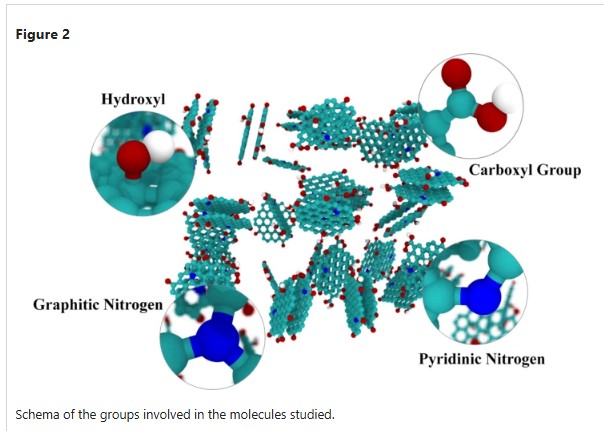
In this study, we combined the experimental analyses and MD simulation to study CO2 adsorption on the porous carbon derived from celery biomass, focusing on the underlying mechanism of physisorption. We applied MD simulation using LAMMPS software (Large-scale Atomic/Molecular Massively Parallel Simulator) to determine a randomly void based on CO2 molecules and investigate its adsorption. The morphology and structure have been characterized by high-resolution transmission electron microscopy, Raman, X-ray diffraction, Fourier transform infrared (FTIR), N2 adsorption–desorption, and X-ray photoelectron spectroscopy (XPS). In both situations (experiment and simulation), CO2 adsorption was investigated at temperatures of 298, 308, and 318 K, under the pressure range of 2–9 bar to assess the simulation’s performance. Due to the lack of experimental data, the amount of adsorption was first investigated by increasing the temperature and pressure, and then this quantity was predicted using simulation at different ranges of temperatures and pressures. Furthermore, the impacts of different types of nitrogen including pyridinic and graphitic, surface chemistry, and size of the simulation box on the CO2 adsorption were investigated utilizing different structures inside the simulated condition. Eventually, using the average absolute value of relative error (AARE %), the accuracy of measurement results was verified. The MD simulation approach is applied because it can effectively predict the atomic level transport phenomenon that is supported by atom/molecule mobility.
Materials and methodology
Identification of porous carbon composition and structure
Porous carbon was synthesized from celery biomass wastes at 700 °C and in 3 h by a one-step self-activating method without the need for an extra reagent (Details of synthesis were described in the previous article)29. The final product was pickled with 1 M HCl to remove the remained impurities and then cleaned with deionized water until neutral pH. Afterward, it was dried in an oven at 90 °C and its final yield reached 13%. The synthesized sample was named C-700 where 700 was the pyrolyzation temperature. All of the chemicals-gases that were used are listed in Table 1. The collection of celery was following the relevant institutional, national, and international guidelines and legislation. Permission for the plant sample collection was obtained from the Forest Association, Tehran. Structural, textural, and chemical characteristics of the synthesized carbon have been investigated as follows: For structure determination of the synthesized powder, X-ray diffraction analysis was performed on BRUKER D8 ADVANCE diffractometer with Cu Kα (λ = 1.54 Å). Micromeritics ASAP2020 (US) adsorption analyzer was employed to measure the N2 adsorption–desorption isotherms at 77 K for the determination of specific surface area, pore volume, and pore size distribution. Before performing the adsorption–desorption analyses, the prepared sample was degassed under dynamic vacuum conditions for 6 h at 150 °C. Fourier transform infrared (FTIR) spectroscopy was conducted with KBr pallets on Perkin–Elmer Spectrometer to distinguish surface functional groups. X-ray photoelectron spectroscopy (XPS) analysis was accomplished by XPS Spectrometer Kratos AXIS Supra and using an Al Ka source to determine the types of functional groups and elemental compositions. Raman spectroscopy was conducted on a Takram micro-Raman spectrometer (Teksan™, Iran). High-resolution transmission electron micrographs were observed on a 300-kV FEI (US) TITAN microscope (HR-TEM).
لینک متن کامل مقاله در nature:
https://www.nature.com/articles/s41598-022-12596-5