

Abstract
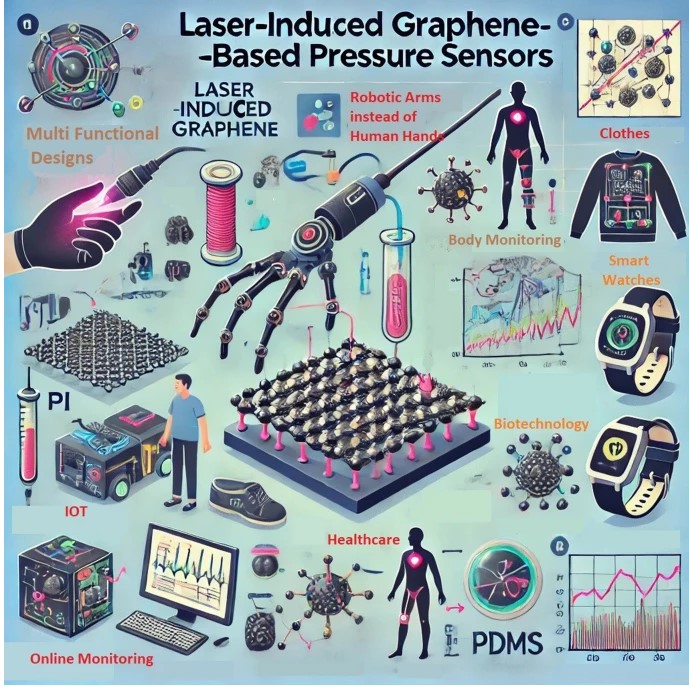
Laser-induced graphene (LIG) has emerged as a transformative material for advanced pressure sensors, uniquely bridging the gap between high performance and manufacturability. Its direct-write, single-step fabrication under ambient conditions sets it apart from other nanomaterials like CNTs and MXenes, offering an unparalleled blend of cost-effectiveness, scalability, substrate versatility, and high performance. This review examines the mechanisms, fabrication techniques, and applications of LIG-based sensors, focusing on their piezoresistive behavior, dynamic bridging effect, and encapsulation strategies for enhanced durability. Optimized laser parameters and micro/nanostructure engineering have significantly improved sensitivity, response time, and detection range. LIG sensors excel in applications such as wearable electronics, health monitoring, and IoT platforms, enabling real-time tracking of heart rate, blood pressure, respiration, tactile sensing, and environmental parameters. Key advancements include rapid response times (< 40 ms), robust long-term performance, and high sensitivity. However, challenges like achieving large-area uniformity, enhancing environmental stability, and advancing miniaturization persist. Future directions emphasize integrating LIG sensors with energy-harvesting systems, dual-function platforms, and AI-driven analytics for smart monitoring. In conclusion, LIG-based pressure sensors present a transformative solution, offering scalable fabrication alongside remarkable versatility and high performance. Their potential to revolutionize flexible, wearable, and intelligent sensing systems positions LIG as a foundational material for next-generation applications.
لینک متن کامل مقاله در SPRIGER :
https://link.springer.com/article/10.1007/s10853-025-11643-6